Shoulder Replacement
Restoring Comfort and Function to a Damaged Shoulder Joint
Shoulder replacement surgery is used to treat severe shoulder pain, arthritis, and loss of function when conservative treatment is no longer providing adequate relief. The procedure replaces damaged portions of the shoulder joint with prosthetic components designed to improve comfort, restore function, and help patients return to daily activities.
Shoulder replacement may be considered when symptoms significantly interfere with sleep, reaching, lifting, dressing, and other routine activities.
Conditions That May Lead to Shoulder Replacement
Shoulder replacement may be considered for:
- Osteoarthritis
- Severe joint degeneration
- Rheumatoid or inflammatory arthritis
- Rotator cuff tear arthropathy
- Avascular necrosis
- Complex shoulder fractures
- Significant cartilage loss
- Persistent pain and loss of function despite nonsurgical treatment
Not every patient with shoulder pain requires surgery. Treatment depends on the severity of joint damage, symptoms, function, age, activity level, and response to conservative care.
Symptoms That May Require Evaluation
You may benefit from an orthopaedic evaluation if you are experiencing:
- Persistent shoulder pain
- Night pain
- Severe stiffness
- Difficulty lifting or reaching
- Loss of range of motion
- Weakness
- Grinding or catching in the shoulder
- Difficulty with dressing, grooming, or other daily activities
- Symptoms that continue despite medications, injections, or physical therapy
Nonsurgical Treatment Options
Before considering surgery, treatment may include:
- Activity modification
- Anti-inflammatory medications
- Corticosteroid injections
- Physical therapy
- Home exercise programs
- Temporary changes to work or recreational activities
When pain and loss of function continue despite appropriate nonsurgical treatment, shoulder replacement may be considered.
Total Shoulder Replacement
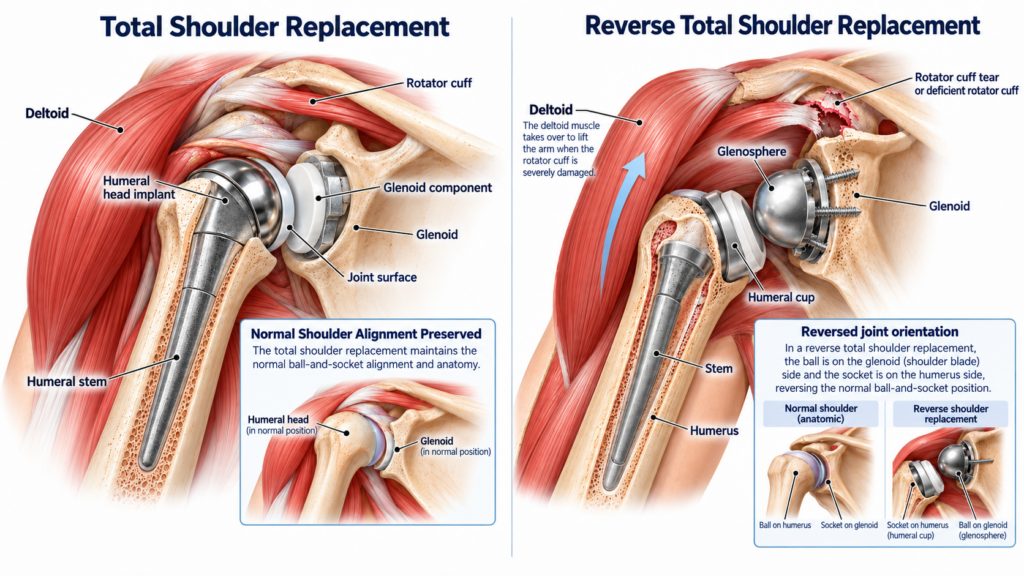
A total shoulder replacement is designed to restore the natural ball-and-socket anatomy of the shoulder. In this procedure, the damaged humeral head is replaced with a metal ball component, and the damaged socket is resurfaced or replaced with a prosthetic socket component.
Total shoulder replacement may be considered when:
- The shoulder joint is significantly damaged by arthritis
- Joint cartilage has worn away
- Pain and stiffness limit function
- The rotator cuff is still functioning adequately
For the right patient, total shoulder replacement can improve pain, motion, and overall shoulder function.
Reverse Total Shoulder Replacement
A reverse total shoulder replacement changes the normal ball-and-socket orientation of the shoulder joint. In this design, the ball component is placed on the shoulder socket side and the socket is placed on the upper arm side.
This allows the deltoid muscle to help move the arm when the rotator cuff is severely damaged or no longer functioning properly.
Reverse total shoulder replacement may be considered for:
- Rotator cuff tear arthropathy
- Massive irreparable rotator cuff tears
- Certain complex fractures
- Failed prior shoulder surgery
- Severe pain and dysfunction when a standard total shoulder replacement may not be appropriate
Reverse total shoulder replacement is often recommended when both arthritis and significant rotator cuff damage are present.
How the Procedure Is Chosen
The decision between total shoulder replacement and reverse total shoulder replacement depends on several factors, including:
- The condition of the joint surfaces
- The severity of arthritis
- The condition of the rotator cuff
- Bone quality
- Prior injury or surgery
- The patient’s symptoms, function, and goals
A thorough examination and imaging review help determine which procedure is most appropriate.
What Happens During Shoulder Replacement Surgery?
During surgery, the damaged portions of the shoulder joint are removed and replaced with prosthetic components.
Depending on the procedure, surgery may involve:
- Replacing the damaged humeral head
- Replacing or resurfacing the socket
- Implanting a total shoulder replacement
- Implanting a reverse total shoulder replacement
- Addressing surrounding damaged tissue when necessary
The exact surgical plan depends on the patient’s diagnosis and anatomy.
Recovery After Shoulder Replacement
Recovery occurs gradually and is individualized for each patient.
A sling is typically worn for a period of time after surgery to protect the shoulder while healing.
Rehabilitation may focus on:
- Protecting the shoulder during healing
- Restoring range of motion
- Improving strength
- Gradually improving shoulder function
- Returning to daily activities
- Improving comfort with sleep and routine movement
Your rehabilitation plan and activity restrictions will depend on the type of replacement performed and your progress after surgery.
Is Shoulder Replacement Right for You?
Shoulder replacement may be considered when severe shoulder pain and loss of function interfere with daily life and have not improved with appropriate conservative treatment.
The decision to proceed with surgery is made after reviewing your symptoms, examination, imaging, treatment history, overall health, and personal goals.
Take the Next Step Toward Better Shoulder Function
Schedule an orthopaedic evaluation to determine the cause of your shoulder pain and discuss whether total shoulder replacement, reverse total shoulder replacement, or another treatment option may be appropriate for you.